Wear: Hold Through Longer Takes
When you record an online course, webinar, or multi-hour interview, editors frequently cut from a clip filmed at 9:15 AM straight to a clip filmed at 1:30 PM. If your forehead goes from satin-matte to glaringly shiny or your lip colour disappears between segments, the jump cut jars the viewer. Endurance on camera comes from smart layering before you start and subtractive touch-ups between modules.
Why Long Recording Sessions Break Down Makeup
Shutting windows and turning off air conditioning for clean audio raises studio ambient temperature by 3–5°C.
Speaking non-stop flexes the perioral muscles around the mouth and chin thousands of times per hour.
Over-ear monitoring headphones and lavalier adjustments rub product off the jawline and temples.
Session Maintenance by Recording Interval
Expand each recording milestone below for the exact 90-second reset procedure between takes.
Before filming a session longer than 60 minutes, mist an alcohol-free film-forming setting spray (containing VP/VA copolymer or acrylates copolymer) onto the face right after blending your liquid foundation and concealer, while the creams are still flexible. Let it dry for 45 seconds, then press a minimal veil of setting powder exclusively onto the T-zone. This polymer network keeps pigment locked even if you perspire under warm lights.
Never apply fresh powder directly onto mid-session shine. Sebum mixes with additional powder to form a thick, visible paste that accentuates pores on 4K sensors. Take an unpowdered abaca-leaf or linen blotting sheet, press it firmly against the center forehead, nose bridge, and chin for three full seconds, and peel it off. In 80% of cases, removing the surface oil restores the original matte finish without adding any extra product.
Check the inner corners of your eyes, the outer corners of your lips, and your smile lines. Use a pointed paper-stem cotton swab to lift any tiny accumulation of concealer or lip product. Tap the area lightly with the clean side of a dry cosmetic sponge to re-smooth the remaining base.
After two hours of drinking water and speaking, lip contrast drops and natural facial flushing can make the nose look redder than the cheeks. Tap a tiny dot of concealer around the base of the nostrils, and reapply a satin-finish tinted lip balm or stain that matches your natural lip tone plus one step of depth.
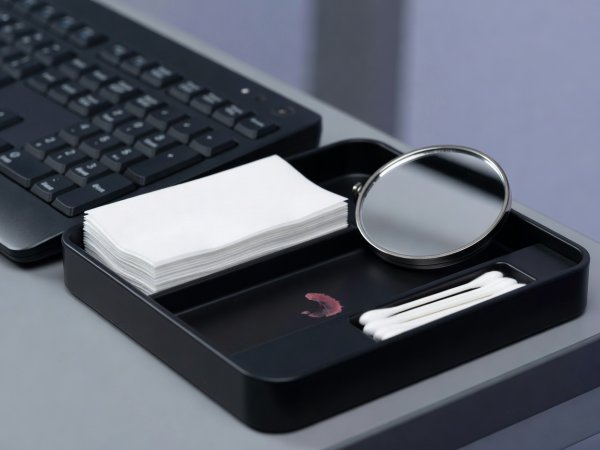
Keep Hands and Compacts Away from the Mic
Snap-shut plastic powder compacts and crinkling tissue paper create loud transient spikes on condenser microphones if you touch up while audio is still rolling. Keep your touch-up items open on a soft felt mat out of camera frame during live webinars.
The 5-Item Desk Touch-Up Tray
Keep these five items within arm's reach of your recording chair so you never have to leave your lighting position to fix shine.
Plain Linen Blotting Papers
Choose un-powdered, fragrance-free sheets so they lift oil cleanly without shifting the colour of your foundation across multiple takes.
Pointed Cotton Swabs
Essential for clearing a speck of mascara, inner-eye moisture, or lip-corner buildup with millimeter precision.
Translucent Pressed Blot Powder + Puff
Look for a dedicated "blotting powder" formula formulated with low pigment load specifically for mid-day touch-ups without caking.